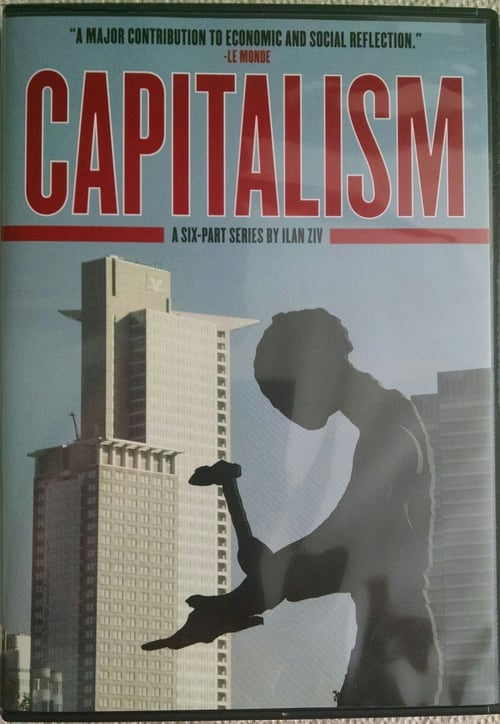
Capitalism
(2014)
★ 8.7 IMDb · 114 votes
Genres: Documentary
Year: 2014
Runtime: 320 мин
Country: France, Canada
Director: Ilan Ziv
Plot
CAPITALISM is an ambitious and accessible six-part documentary series that looks at both the history of ideas and the social forces that have shaped the capitalist world. Blending interviews with some of the world’s great historians, economists, anthropologists, and social critics with on-the-ground footage shot in twenty-two countries, CAPITALISM questions the myth of the unfettered free market, explores the nature of debt and commodities, and retraces some of the great economic debates of the last 200 years. The series features some of the world’s top economists, historians, anthropologists, and sociologists, including Thomas Piketty, Noam Chomsky, Yanis Varoufakis, Nicholas Phillipson, Kari Polanyi Levitt, David Graeber, and Abraham Rotstein. - icarusfilms.com
In the early days of the system, that came to be known as Capitalism, political economists of all stripes struggled to understand the laws that govern the flow of capital - and of Capitalism's related activities. As a result, a critical assessment and sketchy understanding of how Capitalism worked began to emerge. But in recent times, as the system, and the world, has grown a hundredfold more complex we have veered away from the pursuit of any clear, critical understanding of the phenomenon. Economic departments in most major universities in the English-speaking world have abolished courses in the history of Economic and political economy. We are left with incomprehensible mathematical models whose relevance to the real world is hotly disputed. We were told very little about Adam Smith, David Ricardo and Thomas Malthus yet their names have been used to give legitimacy to contemporary economic activities. To further obscure the issues, this « econo speak » has been supplemented by endless superficial news reports, pundits discussions and analysis filled with clichés and superficial information. Our series intends to puncture this veil of opacity to go beyond the current « econo- speak » to re examine the ideas which have been used in the past 40 to reshape the world. Is today's economic crisis a temporary blimp on the road to progress or a symptom of a deeper crisis of the system as a whole? Can the big ideas of the at the heart of our Economic system help us understand today's economic crisis, or obscure it? And more importantly - can they show us a way out?